
The Ultimate Guide to Titanium Implant Machining: Precision, Challenges, and Best Practices
Introduction
When we talk about titanium implant machining, we’re describing a specialized discipline within precision manufacturing—one that sits at the intersection of advanced materials science and medical device quality. At Implantmfg, we see this every day: a single femoral stem, a custom spinal cage, or a trauma plate must be machined to tolerances that would make standard CNC shops nervous. And that’s exactly what our customers expect.
The demand for custom titanium implants has grown rapidly, driven by patient-specific anatomy requirements, improved surgical techniques, and a shift toward personalized medicine. Whether it’s a prototype for a startup or a repeat production run for an established orthopedic company, the material of choice is often titanium. But machining it is far from straightforward. Heat buildup, rapid tool wear, and the need for ±0.0005″ accuracy means you can’t treat titanium like aluminum or steel. Over the years, we’ve learned that success comes from understanding the metal’s behavior, selecting the right tools and parameters, and controlling every variable in the process.
In this guide, I’ll walk through what we’ve found to be the essential knowledge for titanium implant machining—from material properties to finishing techniques—so you can make informed decisions for your next project.
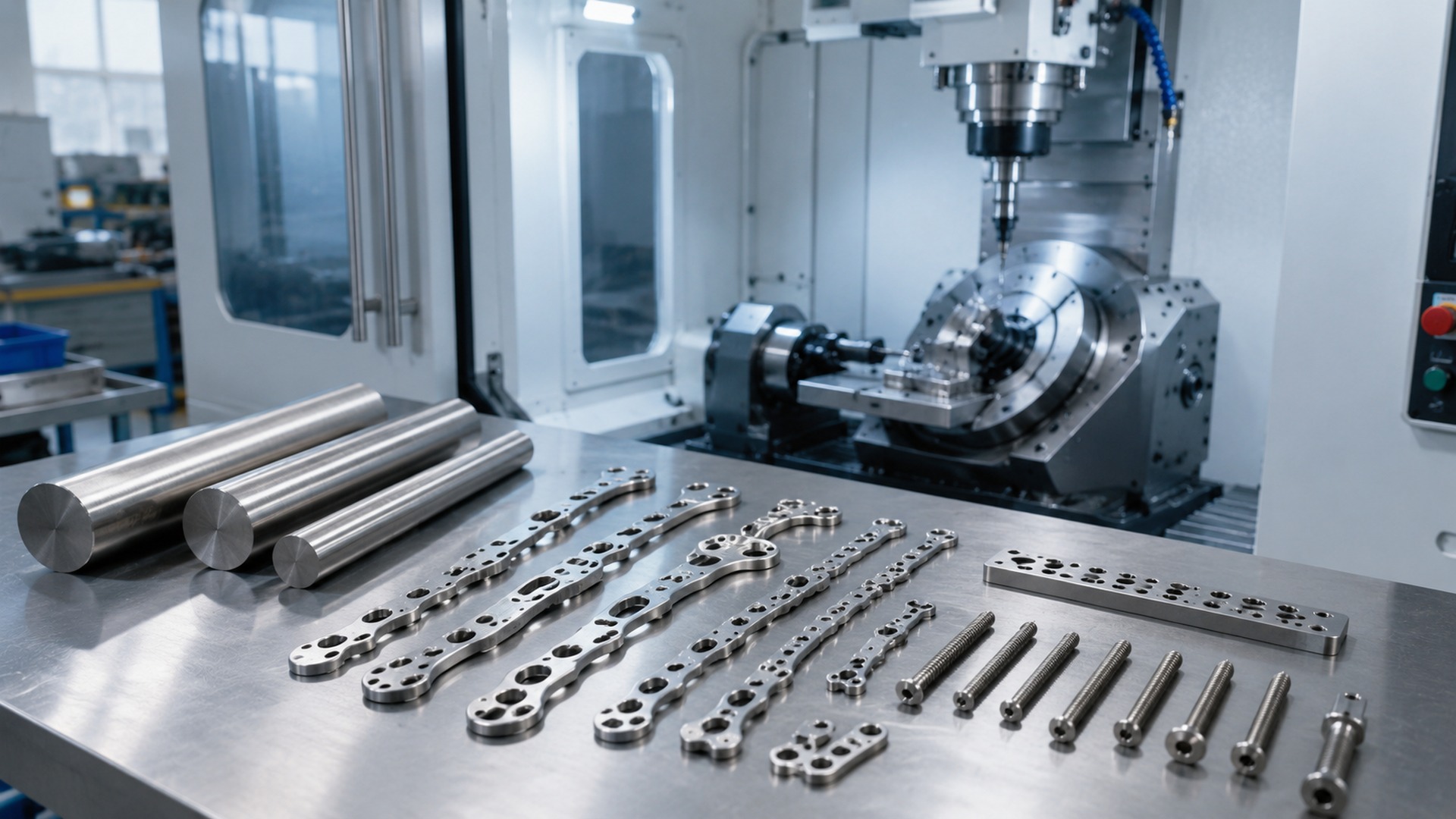
Why Titanium? Key Properties for Medical Implants
Titanium isn’t the easiest material to machine, but its properties make it the first choice for load-bearing implants. Here’s why:
- Biocompatibility: Titanium is non-toxic and, more importantly, it osseointegrates—bone cells grow directly onto the implant surface. This creates a stable, long-term bond.
- Corrosion resistance: The natural oxide layer protects against body fluids, so implants don’t degrade or release harmful ions over time.
- High strength-to-weight ratio: Titanium is about 40% lighter than stainless steel, yet its strength is comparable. That reduces the fatigue load on the patient’s bone.
- Non-magnetic: Patients with titanium implants can safely undergo MRI and other imaging without interference or heating.
For these reasons, we recommend titanium for most orthopedic, spinal, and dental implant applications whenever mechanical load is a concern.
Popular Titanium Alloys for Implant Machining
Not all titanium is the same. The alloy you choose directly affects both implant performance and our machining strategy. Here are the grades we work with most:
Grade 5 (Ti-6Al-4V)
The workhorse of aerospace and medical. It offers high strength, good fatigue resistance, and is widely used for orthopedic implants like hip stems and knee components. Machinability is moderate—it’s harder than pure titanium and tends to work-harden quickly.
Grade 23 (Ti-6Al-4V ELI)
Extra Low Interstitials. This is our preferred grade for long-term implants such as hips, knees, and spinal fixation devices. The reduced interstitial elements (oxygen, iron, carbon) improve ductility and fracture toughness. It’s slightly easier to machine than Grade 5, but still requires careful parameter selection.
Grade 2 (Commercially Pure)
Softer and more ductile. We often use Grade 2 for dental abutments, trauma plates, and temporary implants. It machines more easily than the alloys—less tool wear, lower cutting forces—but final part strength is lower.
Alloy Selection Impact
We always advise our customers: the alloy affects not only the implant’s in-vivo performance but also our machining costs and lead times. Grade 23 may cost more per pound, but its machinability advantage can offset that in small batches. For short-run prototypes, we often suggest Grade 2 for quick iteration, then validate with Grade 23 for production.
The Core Challenges of Titanium Implant Machining
Titanium is classified as a difficult-to-machine material. Here are the specific headaches we deal with daily:
- Low thermal conductivity (≈7 W/m·K): Heat generated during cutting stays at the tool-chip interface instead of dissipating. This rapidly accelerates tool wear and can cause thermal damage to the workpiece surface.
- Work hardening: The material’s surface hardens under mechanical deformation. If you take a light cut over a previously machined area, the tool encounters a harder layer, causing edge chipping or breakage.
- Galling and built-up edge (BUE): Titanium has a high chemical affinity for carbide tool materials. At cutting temperatures, it welds to the tool edge, leading to poor surface finish and unpredictable tool life.
- Vibration and chatter: Many implant features—thin webs, small radii, undercuts—are prone to deflection. Even a few thousandths of deflection can scrap a part.
- Stringent cleanliness: Chips and coolant residue must be completely removed. Any contamination can cause adverse biological reactions. We maintain separate work zones and cleaning protocols for medical titanium.
Does Titanium Have Good Machinability? (PAA Answer)
The short answer: no. Compared to aluminum or even stainless steel, titanium is considered poor in machinability. The reasons are well known:
- Low thermal conductivity causes heat concentration.
- High chemical reactivity leads to BUE.
- Titanium’s spring-back (elastic recovery) complicates dimensional control.
However, “poor machinability” doesn’t mean impossible. With proper techniques, we consistently achieve tight tolerances and excellent surface finishes. The key is to respect the material’s behavior—slow down, stay cool, and keep the tool sharp.
Essential Machining Parameters for Titanium Implants
Getting parameters right is the single biggest factor in success. Here’s what we typically use for implant-grade titanium (Ti-6Al-4V ELI):
| Parameter | Recommended Range | Notes |
|-----------|-------------------|-------|
| Cutting speed (SFM) | 30–60 (0.15–0.3 m/s) | Much lower than steel (200+ SFM) |
| Feed per tooth (IPT) | 0.002–0.008″ | Light to moderate; avoid underfeeding |
| Depth of cut – roughing | 0.040–0.100″ | Only in rigid setups; use radial engagement ≤50% |
| Depth of cut – finishing | 0.010–0.040″ | Light axial and radial engagement for surface finish |
| Tool coating | AlTiN, TiAlN, DLC | Multilayer coatings reduce crater wear |
What RPM for Milling Titanium? (PAA Answer)
You can calculate RPM using the standard formula:
RPM = (SFM × 3.82) / Cutter Diameter (inches)
For example, a 1/2″ end mill at 50 SFM:
RPM = (50 × 3.82) / 0.5 = 382 RPM
That’s slow compared to aluminum, but it’s correct for titanium. Going faster will overheat the tool and ruin edge integrity.
Cutting Tool Selection and Geometry
We’ve tested dozens of tool geometries and coatings. For titanium implants, we standardize on:
- Carbide substrates: Micrograin carbide with high cobalt content for toughness. HSS tools simply don’t last.
- Positive rake angles: Reduces cutting forces and heat generation. A 10–15° radial rake is typical.
- Sharp edges: Dull tools increase pressure and work hardening. We change inserts before they become dull.
- AlTiN coating: Excellent hot hardness and oxidation resistance. TiAlN is also good; we avoid TiN alone.
- Climb milling: Always preferred. It reduces cutting forces and prevents the tool from rubbing against the work-hardened surface.
For roughing, we sometimes use ceramic or CBN tools at higher speeds (200+ SFM) with small depths of cut. These materials handle heat better but are brittle, so we reserve them for rigid setups.
Cooling and Lubrication Strategies for Titanium
Heat management is everything. Our standard is high-pressure flood coolant directed at the cutting zone:
- Pressure: 800–1000 psi (55–70 bar) to break chips and penetrate the cutting edge.
- Through-tool coolant: Ideal for deep cavities and drills; ensures consistent cooling.
- Flow rate: At least 5 gallons per minute per tool.
We avoid minimal-quantity lubrication (MQL) for titanium—it doesn’t remove enough heat. For medical applications, we also use specialized oil-free coolants (e.g., Pure‑Cut) to prevent residue that could affect biocompatibility.
Emerging trends include cryogenic cooling (liquid nitrogen), which we’ve piloted on aerospace implant projects. It reduces tool wear dramatically but adds infrastructure cost.
Fixturing and Vibration Control
Implant parts are often small, thin-walled, or have delicate features. Here’s how we maintain stability:
- Custom soft jaws: Machined to match the part contour; we use aluminum or brass jaws to avoid marring.
- Vacuum fixturing: For thin plates and flat parts; holds without distortion.
- 5-axis tombstones: For complex geometries needing multiple access angles in one setup.
- Damping: We sometimes add tuned mass dampers to the workholding or use stable vises with wide contact areas.
A practical tip: when machining thin sections, leave 0.020″ stock for finishing passes. The rough cuts relieve stress; the finish pass removes the distorted layer.
Does Titanium Warp When Machining? (PAA Answer)
Yes, titanium can warp, and it’s a common source of scrap. Two mechanisms:
- Residual stress release – The raw bar or billet contains internal stresses. As you remove material, the part distorts.
- Thermal expansion – Uneven heating during machining causes localized expansion, which leads to distortion after cooling.
How we prevent warpage:
- Roughing + stress relief + finishing: We rough-cut, then perform a stress-relieving heat treatment (typically 4 hours at 1300°F, air cool), then finish. This is standard for precision implants.
- Low-torque finishing passes: Light cuts minimize heat input.
- Allow cooling between cuts: We sometimes pause the cycle to let the part return to room temperature.
- Simulation software: We use advanced CAM that predicts distortion based on material properties and toolpath.
Achieving Tight Tolerances and Surface Finish
Medical implant tolerances are unforgiving. We work to:
- Dimensional tolerance: ±0.0005″ (±0.013 mm) for critical mating surfaces; ±0.001″ for general features.
- Surface finish: Ra 0.4 µm for articulating surfaces (e.g., knee femoral component); Ra 0.2 µm for bone-contact surfaces to promote osseointegration.
To achieve this:
- Finishing passes with wiper inserts: These have a better surface finish geometry.
- High spindle speed, very light radial engagement (0.010–0.020″).
- Ball end mills for 3D contours.
- Post-machining processes: Deburring, vibratory finishing, and electropolishing to ASTM F86 standards.
We also use CMM and optical inspection to verify every critical feature.
Design for Manufacturability (DFM) for Titanium Implants
We often help customers adjust their designs to make titanium machining more reliable and cost-effective. Here are our top DFM guidelines:
- Avoid sharp internal corners: Use radii ≥ 0.020″ (0.5 mm). Sharp corners create stress risers and break small end mills.
- Limit hole depth-to-diameter ratio: ≤ 4:1 for standard drilling; otherwise use step drilling or peck cycles. Titanium chips are difficult to evacuate from deep holes.
- Provide tool clearance: Ensure there’s enough room for the toolholder to reach deep cavities and undercuts. We often recommend adding relief slots.
- Consider 5-axis setups: By orienting the part, we can reduce the number of setups and improve accuracy. For example, a spinal cage can be machined from one side with tilt-rotary axes.
We always offer a free DFM review before quoting. It saves time and money.
Titanium vs. Other Implant Materials
| Material | Relative Machinability | Strength | Biocompatibility | MRI Safe | Typical Use |
|----------|------------------------|----------|------------------|----------|-------------|
| Titanium (Ti-6Al-4V) | Fair | High | Excellent | Yes | Orthopedic, spinal |
| 316L Stainless | Good | Medium | Good | No (ferromagnetic) | Temporary implants, instruments |
| Co-Cr (Cobalt-Chrome) | Difficult | Very high | Good | No (magnetic) | Long-term wear surfaces (hips) |
| PEEK | Excellent | Low | Excellent | Yes | Non-load-bearing (spacers) |
For load-bearing implants, titanium offers the best balance of strength, biocompatibility, and MRI compatibility. That’s why it’s our most requested material.
Industry Standards and Certifications for Titanium Implants
We manufacture under a quality system aligned with:
- ISO 13485: Medical device QMS.
- ASTM F136 and ASTM F1472: Specifications for wrought titanium (Grade 23 and Grade 5, respectively).
- FDA 21 CFR 820: Quality System Regulation.
- Material traceability: Every batch is linked to a mill certificate. We maintain full chain-of-custody records.
- Cleanroom packaging: For critical components, we pack in a Class 10k cleanroom and validate cleanliness.
Our customers rely on this documentation for their regulatory submissions.
Cost Drivers in Titanium Implant Machining
Titanium implant machining is inherently more expensive than standard medical parts. The key cost factors:
- Raw material cost: Grade 23 titanium costs 5–10× more than 316L stainless. We minimize waste through near-net-shape stock selection.
- Machining time: Titanium cycles are 2–5× slower than aluminum. A simple plate might take 20 minutes in aluminum, 90 minutes in titanium.
- Tooling cost: Frequent tool changes; we use premium coated carbide. Expect per-part tool cost to be 2–3× higher than steel.
- Secondary operations: EDM (for complex features), laser marking, surface treatments, CMM/CT inspection.
- Risk mitigation: We often offer risk-free trial runs (first article at zero risk) to validate process before committing to production.
Future Trends in Titanium Implant Machining
We’re investing in several technologies that will shape the next decade:
- 5-axis machining with automation: Single-setup production of complex spinal and custom joint implants. Robotic part loading enables lights-out runs.
- AI-driven tool wear monitoring: Real-time spindle load and vibration analysis that adapts feeds to maintain tool life.
- Additive + subtractive hybrid: Printing a near-net-shape titanium blank (using L-PBF or EBM) then finish machining. This reduces material waste by up to 80%.
- Sustainable machining: Cryogenic and dry machining to eliminate cutting fluid disposal. We’re piloting liquid nitrogen systems.
Frequently Asked Questions (FAQ)
Does titanium have good machinability?
No, it’s considered difficult. But with proper techniques—low speeds, high pressure coolant, sharp tools—high precision is achievable.
What RPM is needed for milling titanium?
Calculate using RPM = (SFM × 3.82) / cutter diameter. For example, a 0.5″ tool at 50 SFM gives 382 RPM.
Does titanium warp when machining?
Yes, due to residual stress release and heat distortion. Use stress-relief heat treatment between roughing and finishing.
Can titanium implants be recycled?
Yes, but titanium for medical use must be segregated and certified. We collect scrap and send it to certified recyclers.
What coolant is best for titanium?
High-pressure flood coolant (800–1000 psi) with biocides to prevent bacterial growth. Avoid MQL.
Conclusion
Titanium implant machining demands a different mindset than general CNC work. It’s not about speed; it’s about control—of heat, force, vibration, and contamination. At Implantmfg, we’ve built our processes around these realities, using specialized tooling, rigorous quality systems, and a deep understanding of the material.
If you’re developing a custom titanium implant, from prototype to production, we’d love to work with you. We offer a free DFM review and a risk-free trial machining run—so you can see the quality before committing.
Contact us today to discuss your project. Whether it’s a single prototype or a repeat production batch, we’ll help you turn your design into a precise, reliable implant component.